
Section 2: Understanding the trap · Chapter 2
The Truss Trap
Reading time: 5 minutes 30 seconds
In this section
Let’s start with the ultimate ghost story used to frighten the British public into accepting permanent decline: the Liz Truss mini-budget of Friday 23rd September 2022.
Every mainstream commentator and orthodox politician has spent the last few years repeating the same campfire tale. The story goes like this: Truss broke the holy “fiscal rules.” She dared to suggest spending money without an accountant’s permission, and the almighty Bond Markets rained down fire and brimstone to punish her insolence. The moral of the story? If you ever try to do anything bold, the markets will crash your economy, spike your mortgage, and destroy your pension fund.
That is not what happened.
The markets did not punish ambition. They choked on a supply of gilts the Chancellor had acknowledged in writing the day before he added to it.
Bond traders are not moral arbiters. They are gamblers responding to basic supply and demand. Their only concern is making a profit on their trades.
When Chancellor Kwasi Kwarteng announced a wave of unfunded tax cuts for the highest earners, he did not particularly offend the sensibilities of international traders — they would have benefited. What he did was ram a massive wave of supply straight into a structural bottleneck.
Bond traders are not moral arbiters. They are gamblers responding to basic supply and demand. Their only concern is making a profit on their trades. They looked at the announcement and concluded that the government was about to flood the market with a glut of new tradable bonds (also called gilts)1 to pay for these tax cuts.
When you flood a market with any asset, its price drops. And when the price of a government bond drops, its interest rate — the yield — spikes.
The incompetence here was worse than ignorance. The day before the mini-budget, the Bank of England confirmed it would start selling its £838 billion pile of gilts2 — £80 billion over the following year. Kwarteng knew. He wrote to the Governor that same day,3 acknowledging the planned sales. Then he stood up the next morning and announced £45 billion a year of unfunded tax cuts regardless.
What traders had expected to be a wave of new bonds now looked like a tsunami. They hit the panic button. Sell, sell, sell. The thirty-year gilt yield rose 120 basis points (a 1.2% interest rate rise)4 in three days, one of the sharpest moves on record.5
One thing to be clear about, since Truss has spent years arguing the opposite. The Bank’s announcement was not the problem. On its own, it moved yields about twenty basis points (raising interest rates by 0.2%), and the market took it in its stride.6 The Bank has gone on selling gilts since then without breaking anything (though at a huge cost). The problem is that a modest, well-telegraphed monetary decision plus one fiscal statement was enough to bring the pension system to the brink inside a week. That is not a story about one bad Chancellor. It is a story about a system so fragile that ordinary policy can break it.
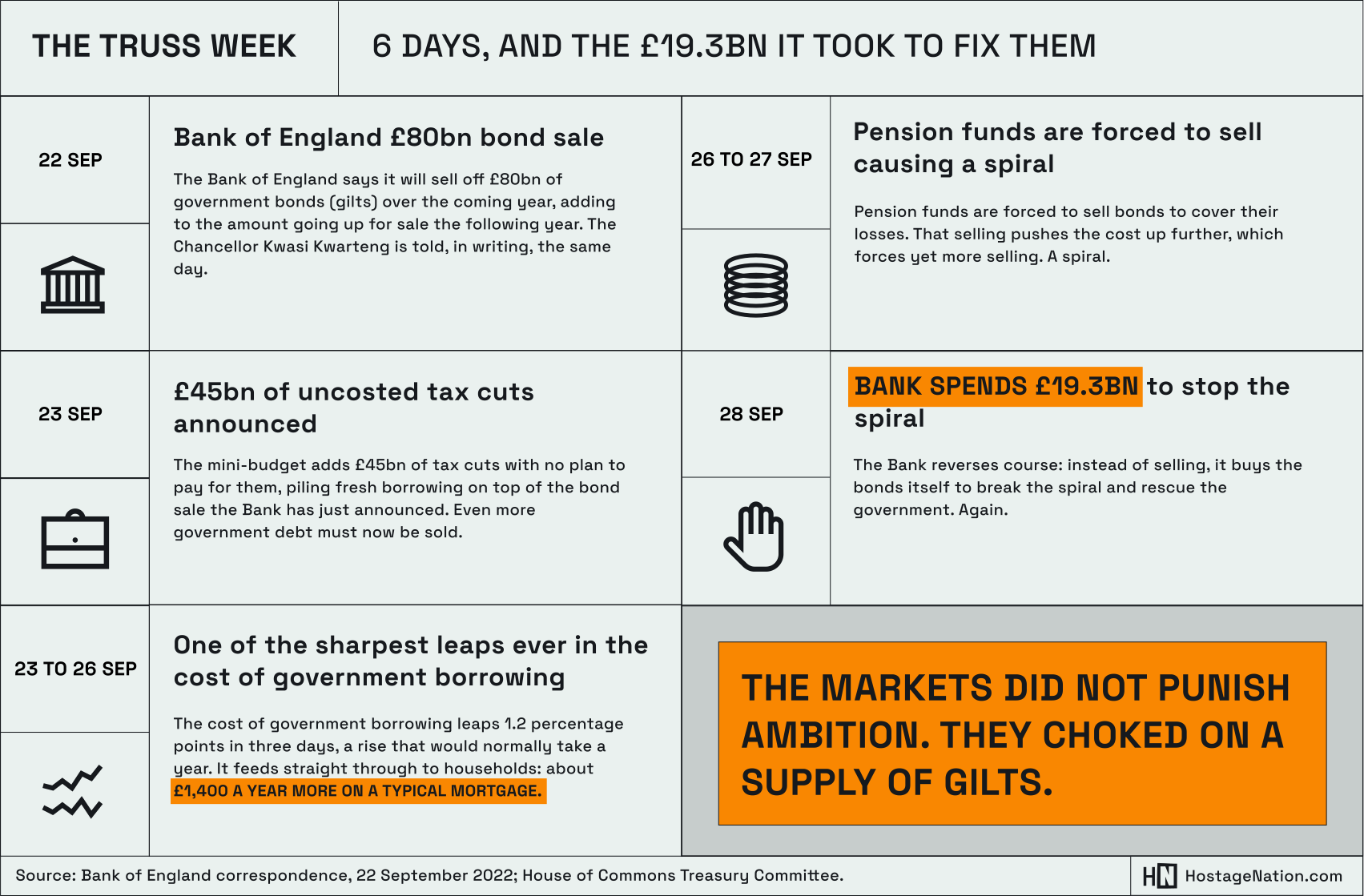
Text description of The Truss Week infographic.
A timeline of six days in September 2022, from Bank of England correspondence dated 22 September 2022 and the House of Commons Treasury Committee.
- 22 Sep, Bank of England £80bn bond sale: The Bank says it will sell £80bn of government bonds (gilts) over the coming year, on top of the amount already due for sale the following year. Chancellor Kwasi Kwarteng is told, in writing, the same day.
- 23 Sep, £45bn of uncosted tax cuts announced: The mini-budget adds £45bn of tax cuts with no plan to pay for them, piling fresh borrowing on top of the bond sale just announced. Even more government debt must now be sold.
- 23 to 26 Sep, one of the sharpest leaps ever in the cost of government borrowing: Borrowing costs jump 1.2 percentage points in three days, a rise that would normally take a year. It feeds straight through to households, at roughly £1,400 a year more on a typical mortgage.
- 26 to 27 Sep, pension funds forced to sell, causing a spiral: Pension funds sell bonds to cover their losses. That selling pushes costs up further, forcing yet more selling. A spiral.
- 28 Sep, Bank spends £19.3bn to stop the spiral: The Bank reverses course and buys the bonds itself to break the spiral and rescue the government.
Here is where the structural design flaw inside the City of London turned a market tremor into a national disaster.
UK pension funds had spent years using highly leveraged financial derivatives called Liability-Driven Investments, or LDIs. On paper the idea was sound, and the regulators were content with it. A pension scheme knows roughly what it owes its members decades from now, and LDIs let it lock in cover for those promises without tying up all its cash.
The catch is how these deals are secured. The fund doesn’t hand over the full value up front. It puts down cash as security, and has to top that up whenever the market moves against it. When the other side of the deal rings to demand more money to cover the changing price, that is a margin call. It is paid in cash, that day, not next month. Miss it, and your position is sold off at whatever price is going.
That is what landed on Britain’s pension funds in the last week of September 2022. Bond prices were falling, so the calls came in, demanding cash. The only asset the funds held in real size was gilts. So they sold gilts to raise the cash. Which pushed gilt prices down further. Which triggered more margin calls.
A classic doom loop, and it took six days to stop. On 28 September the Bank of England postponed the very gilt sales it had announced a week earlier and started buying instead, taking on £19.3 billion to put a floor under the market.7
The roof over your head is pegged to a volatile, speculative derivative market.
And who paid the price? Not the traders. Commercial banks use gilt yields to price residential mortgages. So the moment yields spiked, the cost of shelter for millions of British families was repriced upwards.
Nor did it stop with owners. There are almost two million buy-to-let mortgages in Britain,8 secured against homes that other people rent. Those landlords faced exactly the same repricing, and wherever the local market allowed it, the cost travelled on to the tenant.
The Bank of England’s own forecast was that by the end of 2026, a million British households would be paying over £500 more, and a further two million would be paying between £200 and £500 a month more.9 That’s a family’s food shop, or the gap between managing and struggling.
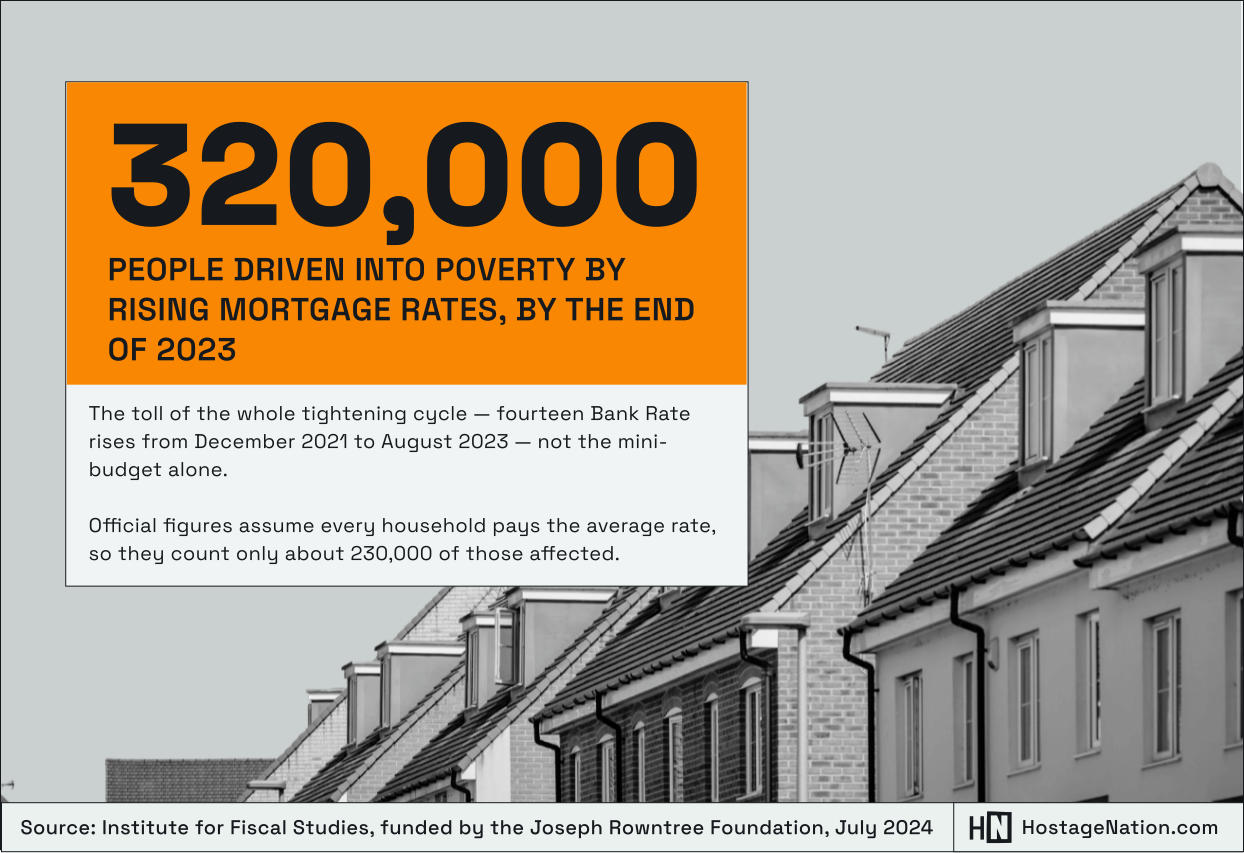
The IFS counted the result. By December 2023, mortgage rate rises had pushed 320,000 people into poverty.10
The mini-budget did not do all of that by itself, fourteen rate rises did. What Truss demonstrated was the speed. In forty-eight hours millions of families were paying more to keep a roof over their heads.
The Truss crisis proved that under our current financial setup, the roof over your head is pegged to a volatile, speculative derivative market. Allowing that to happen isn’t “prudence.” It is failing the citizens of Britain.
- For historical reasons, the most common type of UK Government Bonds are called gilts, because in their paper form they had gold edging. In the case of standard issues government bonds, the words gilt and bond are interchangeable. Some other kinds of bonds, like Premium Bonds, are not gilts. All gilts are bonds, but not all bonds are gilts. ↩︎
- The Bank of England held approximately £838 billion in gilts and confirmed on 22 September 2022, the day before the mini-budget, that it would begin selling some of them, with maturing bonds and sales together projected to reduce holdings by £80 billion over the following twelve months. Full Fact, October 2022. ↩︎
- The MPC’s vote to launch active quantitative tightening was published on 22 September 2022, immediately before the mini-budget of 23 September. Kwasi Kwarteng wrote to the Governor of the Bank of England on the same day, acknowledging the planned gilt sales. Treasury Committee, Quantitative Tightening, February 2024; AJ Bell, September 2025. ↩︎
- The financial markets use the term basis points to mean one-hundredth of a percent. So if the interest rises by 100 basis points, it rises by 1%. ↩︎
- The 30-year gilt yield rose approximately 120 basis points over three days following the mini-budget, one of the largest yield increases recorded in such a period. EFG International, October 2022. ↩︎
- The MPC announcement of 22 September raised yields by around 20 basis points on the day, an adjustment commensurate with the news, which markets absorbed smoothly. Wilkins, Financial Stability and Monetary Policy: Lessons from the UK’s LDI Crisis, Princeton GCEPS Working Paper 336. ↩︎
- On 28 September 2022 the Bank postponed the launch of active quantitative tightening and intervened in the gilt market, ultimately purchasing £19.3 billion of gilts between 28 September and 14 October. Treasury Committee, Quantitative Tightening, February 2024. ↩︎
- UK Finance, Q1 2026: 1.47 million fixed-rate buy-to-let mortgages outstanding and 453,000 variable-rate, totalling approximately 1.92 million. ↩︎
- Bank of England, Financial Stability Report, July 2023. Nearly one million households were projected to see monthly mortgage payments rise by at least £500 by the end of 2026, with more than two million facing increases of between £200 and £499. ↩︎
- Institute for Fiscal Studies, funded by the Joseph Rowntree Foundation, July 2024. By December 2023, mortgage rate rises had pushed an estimated 320,000 people into poverty; because official statistics model mortgage interest rather than measuring it, they capture only about two-thirds of this effect, around 230,000 people. The IFS attributes the effect to the full tightening cycle of fourteen rate rises, from 0.1% in December 2021 to 5.25% by August 2023, not to the mini-budget alone. ↩︎