
In this section
British pension funds hold around £2.1 trillion. The state subsidises that saving by more than £50 billion a year. Five times what it spends on ISAs, and the largest single tax expenditure the Treasury makes. Again, without any conditions about where that money is invested.
Andy Haldane was Chief Economist at the Bank of England. He is now president of the British Chambers of Commerce, and an adviser to the Prime Minister. His account of where the money went is worth following.
In 2000, more than half of UK pension assets were invested in British companies. Today it is under 5%. In cash terms that’s a cumulative withdrawal of over £2.5 trillion over that time, more than the funds hold today, and about the value of every listed company headquartered in this country. Ask the savers and more than 70% say they would prefer a system that favoured British firms. Many assume it already does.
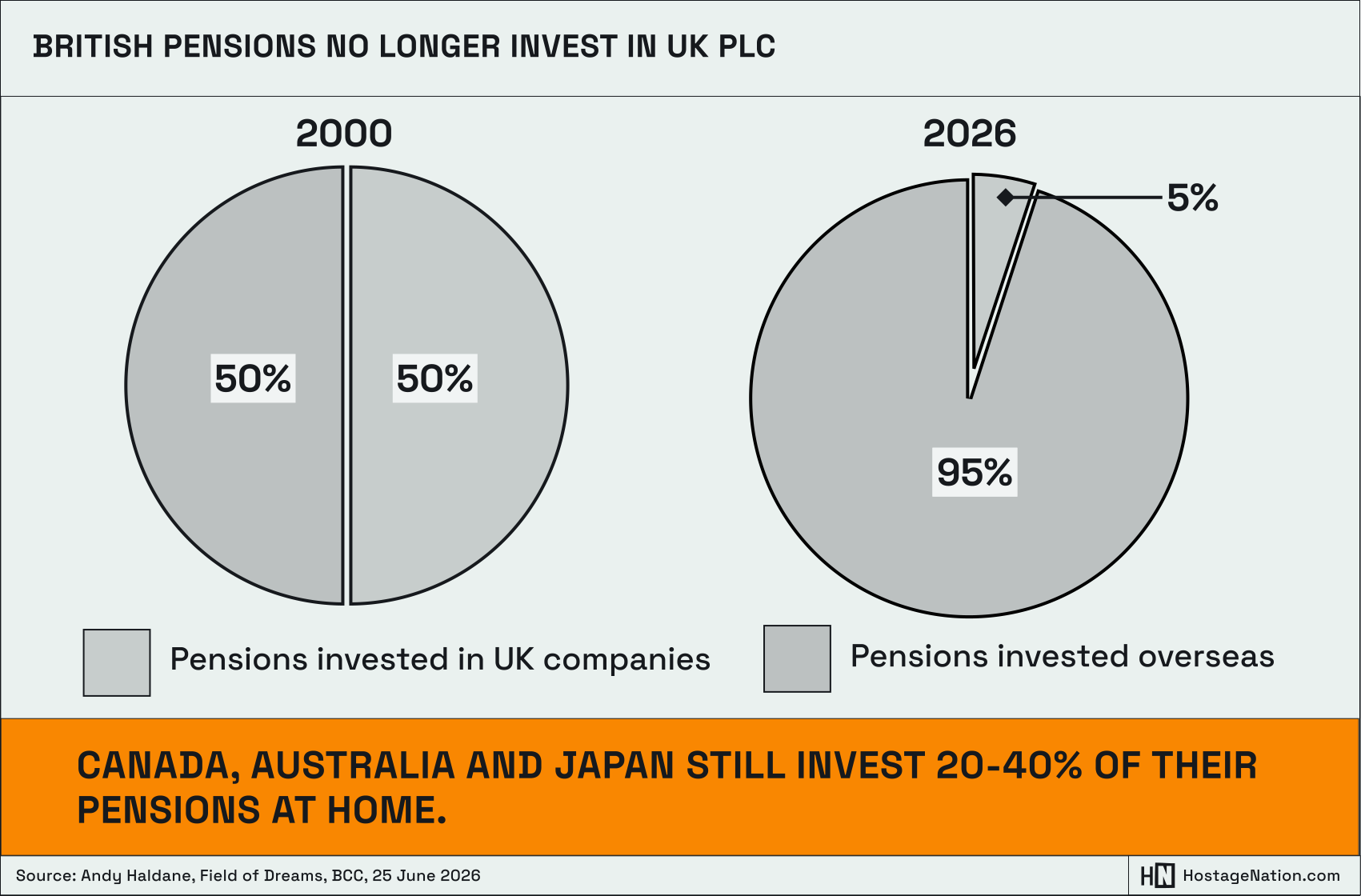
Britain used to do exactly this. Before 1997 the dividend tax credit favoured pension fund investment in British companies, and Personal Equity Plans – which ISAs replaced – carried an explicit domestic bias. This home bias was not lost, it was legislated away.
The principle has been tested since. Chancellor Rachel Reeves proposed requiring schemes to place a share of their funds in UK assets. City firms lobbied against the mandation clause. She buckled. The Pension Schemes Act 2026 passed without it.
Same year, same lobbying ecosystem, same result as the British ISA.
Haldane wants the money in equities, to fund high-growth British firms. That gap is real and his case is sound. If savers want to invest in stocks and shares ISAs, they should be free to invest where they want, but if they want a tax subsidy, that should depend on investing in British business.
“Shares pay what the market decides, when the market decides. A pension scheme knows what it owes in twenty years’ time. What it needs is an asset that pays in twenty years’ time. Infrastructure does that.”
We propose essentially the same instrument as would be available for private savers: National Development Stock. Available in different term lengths. Long-dated, with different fixed rates or index-linked, paying on a schedule. A closer match to a pension scheme’s obligations than equities have ever been. The state can afford to guarantee it because a grid connection pays what the meter says, every quarter, for forty years. Rent on a municipal home arrives every month.
This disposes of the objection that these instruments are illiquid. A pension scheme needs money to arrive when it is owed. Schemes were selling gilts into a falling market in September 2022 because of margin calls on derivatives, not because members retired unexpectedly. That liquidity crisis was manufactured by the liability driven investment structure described in Chapter 2. It is not an inherent feature of paying pensions.
The Pensions Regulator’s model of a well-funded scheme is 85% bonds and gilts, measured against a yardstick of gilts plus half a per cent. National Development Stock, which is a state-backed, index-linked, long-dated instrument, sits inside that framework, giving pension schemes what they need more of.
Then there is the question of fiduciary duty: the pension fund trustees have a legal requirement to act in the best interests of their members. Quite right too. Sometimes there is an objection that serving government policy is not in the financial best interests of the pension fund’s members, even if they might like to see their money invested in Britain.
But that’s a misreading: under our proposal the government is simply setting the tax framework. The trustees have no compulsion to invest in National Development Stock. They just get a tax break if they do. And if that makes the investment more attractive, such an investment is in their members’ interests.
And the precedent exists. The dividend tax credit did precisely this until 1997. Nobody argued then that it put trustees in breach.
One caveat, and it binds the state rather than the trustee. A condition like this is only defensible if the instrument is worth holding on its own terms. Design it badly and you have asked trustees to choose between a tax break and their members. Design it as set out above – long-dated, index-linked, matched to the liability – and no such dichotomy arises.
So the ask is the same as the last chapter.
Not mandation. Nobody’s pension is seized and no trustee is told what to buy. Just a condition on £50 billion a year of public money: if you want tax relief from the people of Britain, some of your savings should be invested in Britain. Not unreasonable.1
- Total funded occupational pension assets stood at approximately £2.1 trillion (ONS, Funded occupational pension schemes in the UK: April to September 2025, released April 2026).
Andy Haldane’s remarks are from Field of Dreams, his address as President of the British Chambers of Commerce to the organisation’s Global Annual Conference, 25 June 2026. He gives UK household gross financial assets of around £9 trillion, three times annual GDP, of which more than £2 trillion sits in bank accounts and around £6 trillion in pensions and other investments including ISAs, and estimates that only around 5% of the total is recycled into British companies. On pensions specifically: over half of UK pension assets were invested in UK equities in 2000 against less than 5% today, a shift he values at more than £2.5 trillion, roughly the market capitalisation of every UK-headquartered listed company. He attributes it to a flight to safety into government bonds and a flight to passivity into global index trackers in which the weight of UK companies is modest. He records that pension funds in Canada, Australia, Japan and across Europe invest between 20% and 40% of assets domestically, and that the UK system is the only one without such a home bias. He cites survey evidence that more than 70% of British investors would prefer a pensions system favouring UK companies, and that many believe more than 40% of their pension is already so invested. He gives pension tax relief as over £50 billion a year and ISA relief as more than £10 billion.
On the historical precedent: Haldane notes that prior to 1997 the UK’s dividend tax credit regime favoured pension fund investment in UK companies, and that Personal Equity Plans, the predecessor to ISAs, carried an explicit bias towards domestic companies. The dividend tax credit for pension funds was abolished by Gordon Brown in his first Budget in July 1997, the same Budget that introduced the first fiscal rules. The stated purpose of the abolition was revenue, not the removal of a domestic preference; the effect was to remove it. Haldane explicitly rejects government mandation of allocation as a step too far, proposing instead that tax relief be conditioned on domestic investment while leaving specific choices with asset managers and trustees. He also suggests a case for the default under pensions auto-enrolment being allocation into UK assets. His focus throughout is corporate equities and domestic growth assets rather than physical infrastructure; the extension of the principle to infrastructure is this report’s, not his.
On the mandation clause: the Chancellor had suggested requiring pension schemes to devote a proportion of their funds to UK investments, but did not mandate it in the Pension Schemes Act 2026, following opposition from City firms during the consultation period. Haldane describes the Act, together with the Mansion House Accord, as well-intentioned but likely modest in quantitative impact. On scheme funding requirements and the low dependency standard, see the note to Chapter 4.
On fiduciary duty: pension scheme trustees are required to act in the best interests of beneficiaries, generally understood as their best financial interests. The Law Commission’s 2014 report Fiduciary Duties of Investment Intermediaries (Law Com No 350) found that this does not require the pursuit of maximum short-term return to the exclusion of other financially material considerations, and that trustees may take account of factors relevant to the long-term interests of members. The conditionality proposed here operates through the duty rather than against it: relief alters the net return on an asset, and a trustee comparing net returns is discharging the duty rather than being directed. Pension tax relief is already conditional in several respects — on registration of the scheme under the Finance Act 2004, on the annual allowance, and on payments being authorised — so conditionality as such is established, and what is proposed is a condition of a different subject matter rather than a novel principle. The relevant historical precedent is the dividend tax credit that pension funds could reclaim until its abolition in 1997, which favoured domestic equity holding and was not treated as compromising trustee duties for as long as it operated.
The counter-argument should be stated fairly: industry bodies contend that conditionality of this kind is direction by another route, since a trustee who declines the condition forgoes relief that competitors will take, and that trustees should not be placed in that position by the tax system. The answer given in the text is that the condition is only defensible where the instrument is competitive on its own terms, which is a constraint on the design of the instrument rather than on the trustee. ↩︎