
In this section
If the money comes back to the state through multipliers, how do we fund the initial outlay?
The answer is off-market financing.
Off-market financing means using financial instruments that are not traded on the secondary market. Instead of relying solely on gilts that can be shorted, dumped or sold in a panic, the state issues additional instruments that cannot be traded at all. They are held by the institutions and citizens who buy them, and paid interest in the same way a savings bond pays it.
The existing bond market continues. The government can refinance maturing gilts and issue new ones as it chooses. That is the ordinary work of the Debt Management Office, and nothing here stops it.
What changes is that a second funding channel opens, and it is not exposed to global market volatility.
“A speculator who wants to hit the panic button can still trade gilts with other speculators all day long. But their panic does not touch our ability to build a railway, a wind farm or a house.”
Which raises the obvious question: if nobody can sell it, how does anyone get their money back?
Non-tradable is different from non-redeemable.
Tradable means you sell to a stranger via an open market, like gilts, blue chip shares or bitcoins. The stranger you’re selling to sets the price. That is where the hostage problem lives. Enough strangers sell at once, the price collapses, the yield spikes, and a family’s mortgage gets more expensive by Friday.
Redeemable means you hand it back to the issuer, at a value written into the contract on the day you bought it. No stranger. No price discovery. No spike.
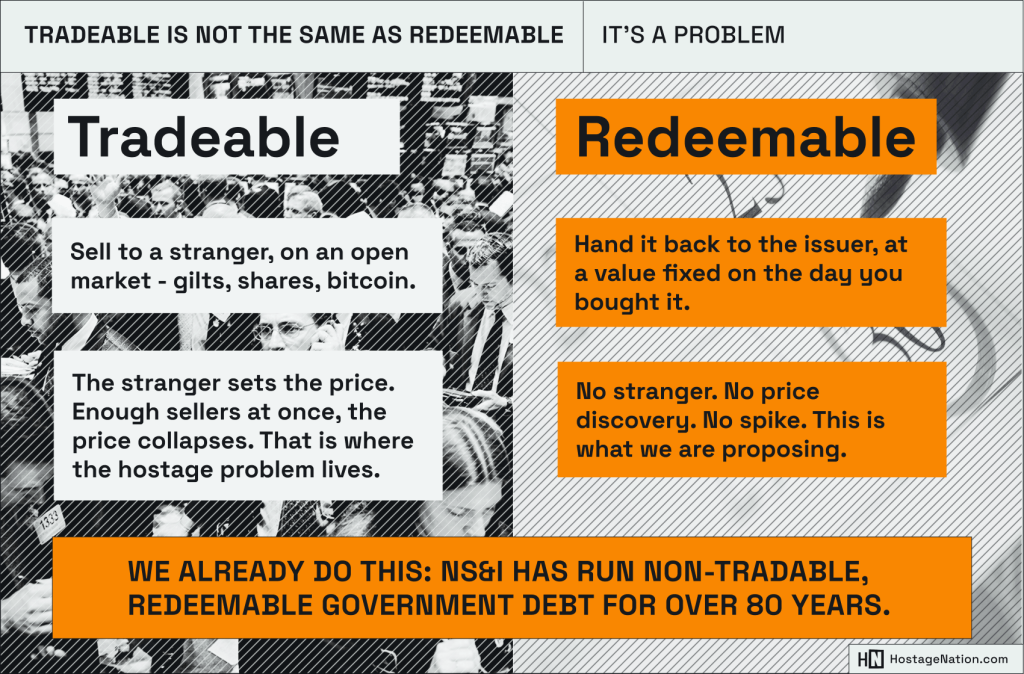
Text description of the Tradeable is not the same as redeemable: it’s a problem infographic
Tradeable: sell to a stranger on an open market, such as gilts, shares or bitcoin. The stranger sets the price. Enough sellers at once and the price collapses. That is where the hostage problem lives.
Redeemable: hand it back to the issuer at a value fixed on the day you bought it. No stranger, no price discovery, no spike. This is what the report proposes.
Closing point: we already do this. NS&I has run non-tradable, redeemable government debt for over 80 years.
What we are proposing to abolish is not your ability to get your money back. It is the ability of a trading desk in another time zone to decide what your pension fund’s financial assets are worth this morning.
We already do this.
None of this is theoretical. Britain has been running non-tradable government debt held directly by citizens for over eighty years.
It is called National Savings and Investment (NS&I) and it already has over 24 million customers. Income Bonds pay a variable rate and you can have your money back whenever you want, with no notice and no penalty. British Savings Bonds pay a fixed rate over three years, for savers who don’t need it back sooner. Green Savings Bonds go further still: three years, no withdrawals at all during the term, and the money earmarked for green projects. Savers buy them anyway. No hedge fund has ever shorted a Premium Bond.1
The money is already here.
We do not need to look abroad for capital.
Start with who doesn’t have it. 13.1 million UK adults have low financial resilience — one in four of us, one shock away from real trouble. One in ten has no savings at all. A further one in five has less than £1,000 to fall back on. That is people living on a financial precipice.2
The other side of the ledger comes from the same survey. Around 15 million adults hold a total of around £610 billion in cash, over and above six months’ income kept back for emergencies. Barclays counts that money and calls it the investment gap. Real money, doing very little.3
We’re not asking those savers for charity. We are offering a fair return on a safe investment, from an institution that cannot run out of pounds. And in exchange, a country where their children have decent work, where their town centre is worth walking into, and where the lights stay on when a gas market panics on the other side of the world.
Not only that, they will get tax relief on the interest they make, just as ISAs and pensions do now. But in return for this tax break it is not unreasonable to ask that their money does some good for the nation. At the moment, we give savings tax breaks even when the money ends up funding US corporations.
Those with an appetite for risk are still free to invest in existing stocks and shares and other volatile assets as they choose. No one is losing their freedom, just their tax subsidy on the unearned income.
Match the instrument to the need
The rest of this section is about design, so here is the principle that governs it.
Different savers need different things. A pension scheme knows what it owes in 2050 and needs a payment that arrives in 2050. A household with £3,000 put by needs to know it can reach it. A company holding cash for payroll needs it on Friday.
The mistake would be to build one product and push everyone into it. The state can instead offer a term to suit the need, and price each one accordingly — longer money earning more, instant access earning less, exactly as the savings market already works. All with safety and security.
Which meets the objection an economist would raise. Not that longer money costs more than instant access — the savings market prices that already. The objection is narrower: against a tradable gilt of the same term, the holder gives up the right to sell, and will want paying for it.
On that like-for-like comparison the tradable bond may price keener, and the comparison leaves out what tradability costs its holder. Liquidity is the right to sell at whatever price the market offers on the day. Anyone holding a long-dated gilt bought in 2020 who needed the money in 2023 found out what that right was worth.4 Redemption at a value written into the contract removes that risk entirely. The schemes dumping gilts into a falling market in September 2022 were not exercising a privilege. They were trapped by one.
Nor is liquidity of equal use for every buyer. Paying a premium for the option to change your mind is worth close to nothing to a pension scheme with no interest in selling because it is matching a payment due in 2050.
And whatever interest premium the state does pay lands in a British pension, or a British savings account.
- NS&I is an executive agency of the Chancellor of the Exchequer, established in 1861 and given its modern savings-bank function over the following century; money invested in its products is used by HM Treasury to contribute to the government’s financing needs. It has more than 24 million customers and all products carry 100% capital security, being backed by HM Treasury. Its Net Financing target — the net contribution it makes to government financing each year — was set at £15 billion, within a range of £4 billion either way, for 2026-27. Product terms as at mid-2026: Income Bonds pay a variable rate with money available at any time, with no notice period and no penalty; British Savings Bonds, relaunched in April 2024 as three-year fixed-rate issues of the older Guaranteed Growth and Guaranteed Income Bonds, take investments between £500 and £1 million; Green Savings Bonds pay a fixed rate over a three-year term during which no withdrawal is possible, with a minimum of £100 and a maximum of £100,000 per issue, and are treated by the Treasury as a policy product rather than a financing one. Source: NS&I corporate reporting and quarterly results. ↩︎
- Financial Conduct Authority, Financial Lives Survey 2024. 13.1 million UK adults, around one in four, have low financial resilience. Approximately one in ten adults have no cash savings at all, and a further one in five hold less than £1,000. ↩︎
- Barclays, The UK Investment Gap, September 2025, analysing the Financial Conduct Authority’s Financial Lives Survey 2024 (fieldwork February to June 2024, 17,950 respondents, published May 2025). Barclays estimates that approximately 15 million UK adults hold around £610 billion of what it terms possible investments in cash; the unrounded figure is £614 billion. The measure counts cash held by individuals with savings above £10,000, after setting aside six months’ income as a reserve, which makes it a conservative estimate, six months’ income being a more generous buffer than the three to six months’ expenditure usually recommended. The comparable estimate from the 2022 survey was 13 million people holding £430 billion, revised to £460 billion on a refined methodology. Barclays attributes around 23% of the subsequent increase to the accrual of interest as Bank Rate rose from 1% to 5.25% over the period, and around 15% to population growth. On what the figure does and does not cover: the underlying survey measures investable assets, which exclude property, defined contribution pension savings and physical assets such as art or jewellery. The population identified here is therefore not wealthy in general but cash-heavy in particular — on the 2024 survey around three in five adults with more than £10,000 in investable assets hold at least 75% of them in cash, and on the earlier survey the largest group held everything in cash. Their holdings of stocks, shares and other investments are small by construction. It also follows that this sum and the pension assets discussed in Chapter 15 are separate pools, and nothing here is counted twice. Two qualifications. The figure is modelled from banded survey responses using range midpoints, and is an estimate rather than a measured stock. And Barclays publishes it to argue for greater retail investment in markets, not for public borrowing: the disagreement in this report is about where the money should go, not about whether it is sitting idle. ↩︎
- The technical objection is that non-tradable debt should command an illiquidity premium relative to a tradable instrument of equivalent term and issuer. On a strict like-for-like basis that is likely correct, and the text does not dispute it. The point made in the text is that a like-for-like comparison omits several countervailing factors. First, tradability carries market risk for the holder. A conventional long-dated gilt purchased at the yields prevailing in 2020 and sold in 2023 would have realised a substantial capital loss; long-dated index-linked gilts fell particularly sharply during 2022. Redemption at a contractual value eliminates that exposure, transferring interest rate risk to the issuer, which is a real cost to the state and should be priced into the instrument’s design. Second, the premium is buyer-specific: it compensates for an option to sell before maturity, whose value approaches zero for a liability-matching investor intending to hold to a known date. Structural demand from that class of investor is rising, as defined contribution default funds de-risk members automatically as they approach retirement and closed defined benefit schemes run off. Third, the gilt yield is an imperfect benchmark at present, since it incorporates a supply effect from active quantitative tightening, discussed in Chapter 18. Fourth, index-linked issuance carries a different risk profile where it finances inflation-linked revenue — rents, regulated grid income, fares — than where it finances general expenditure, which is the mismatch that has made index-linked gilts costly in the past. Fifth, insurers writing annuity business receive capital benefit under the matching adjustment for holding illiquid assets with predictable cashflows matched to their liabilities, so for that buyer non-tradability is not straightforwardly a disadvantage; the Prudential Regulation Authority’s own rationale for the adjustment is that insurers with closely matched predictable asset and liability cash flows are not materially exposed to the risk of being forced sellers. National Savings and Investments demonstrates that non-tradable instruments can be raised at scale over a long period; its rates are benchmarked against the retail savings market rather than gilt yields and therefore do not establish a direct cost comparison. The net position is that the direction of any premium, not merely its size, depends on the instrument, the buyer and the point in the cycle. ↩︎