
Section 4: Raising the money · Chapter 17
The bank belongs to us
Reading time: 10 minutes 30 seconds
In this section
Few subjects generate more heat and less light than the independence of the Bank of England. So let us be precise, because the facts are more interesting than the argument.
The Bank was nationalised in 1946. Its shares are held by the Treasury Solicitor on behalf of the Crown. It has been a publicly owned institution for eighty years.
It does not have independence like Lloyds or Barclays. Parliament sets its mandate. The Chancellor writes to the Monetary Policy Committee (MPC) at least once a year, specifying what price stability means and what the government’s economic objectives are, and the Bank has to follow them. The Chancellor appoints the Governor and the Deputy Governors, and directly appoints the four external members of the MPC. Under the Bank of England Act 1998 the Treasury can direct the Bank on monetary policy. Under the Financial Services Act 2012 it can issue binding directions on financial stability.
What was delegated in 1997 was not the mandate. It was the monthly setting of one instrument against a mandate the government writes. That is narrower than the word “independence” implies. The gap between true independence and the limited operational reality is often deliberately conflated in political discourse.1
What Britain calls central bank independence would not qualify as independence under European treaties. The annual remit letter alone would fail the test, and the Treasury’s power of direction would have to be repealed. We know this because Britain negotiated an explicit exemption from those provisions and held it for twenty-seven years.2
None of this is a scandal, and most of what the Bank does should carry on untouched: the payment system, banknotes, prudential supervision, the daily work of financial stability. There are real questions here about democracy and accountability, and they deserve a hearing elsewhere. This chapter is about three decisions, and whether a government already has the power to take them.
First, halt Quantitative Tightening.
The Bank is unique among major central banks in actively selling its bond portfolio back into a flooded market, locking in capital losses of between £50 and £130 billion. Under an indemnity the Treasury signed in 2009, the taxpayer covers them. That is around £22 billion a year to cover a loss nobody is obliged to take. Held to maturity, most of it does not arise.3
It is also pushing rates up. The Bank’s own estimate is that QT has added 15 to 25 basis points to long-term rates — about £280 a year on a typical new mortgage.4
Does a government have the power to stop the Bank doing this? It doesn’t need one. The indemnity is a Treasury instrument and the money is the Treasury’s. A Chancellor who says the Treasury will indemnify bonds held to maturity but will no longer indemnify losses crystallised by active QT sales is not directing monetary policy. The Chancellor deciding what the Treasury will pay for is the Chancellor’s job.
Second, tier the reserves.
Commercial banks hold roughly £644 billion at the Bank of England. Reserves are simply the money commercial banks keep in their account at the Bank of England. Banks need a working balance to settle payments between each other each day. The £644 billion is far more than is needed for that, because most of it was created by the Bank itself during quantitative easing and had to go somewhere.
The Bank pays Bank Rate on every pound of it, risk-free, on money that sits still. Using the Bank Rate at the time of writing that is over £24 billion a year. It was not always so. Until May 2006 the Bank paid nothing on reserves, and so banks had no reason to maintain large reserves earning no interest. When it began paying, it was to induce banks to keep larger reserves, in sums of tens of billions, to reduce volatility in overnight interbank lending rates. This was all before the financial crash, and before the QE programme that created reserves in the hundreds of billions. Interest rates were near 0% for over 13 years, but when rates rose from 2022, that became very expensive. The system was designed for a different era, and base rate has been paid on every pound of them ever since.5
Take Lloyds. Its largest shareholder is BlackRock. Its third largest is Norges Bank, Norway’s sovereign wealth fund. Some of that payment leaves the country as a dividend cheque to Oslo.6
The European Central Bank, the Swiss National Bank and the Bank of Japan have all operated tiered reserves. Britain never has. Several institutions have costed a British version, and the estimates differ according to how much is left unremunerated and the Current Bank Rate. The New Economics Foundation estimated in 2023 that tiering would save £11.5 billion a year.7 That’s enough to pay the wages of around 300,000 council workers. Care workers, youth workers, librarians, park keepers, planners, transforming local services. And every pound of it would be spent in the towns where those people live.8
At present this is an operational decision for the Bank. But the Treasury has its own route: a levy on the interest banks receive on reserves is a Finance Bill measure, and needs an instruction to nobody. The Bank keeps its framework intact. The Treasury taxes the receipt. The net effect is much the same, a fact that would not be lost on any Governor, who might then prefer to reach an accommodation with the Chancellor.
Third, bring monetary policy inside economic policy.
So who should set interest rates? The substantive change is to the mandate, and it doesn’t depend on the institution. The advice that shapes monetary policy should be formed against the government’s economic objectives in the round, rather than a single inflation number, and those objectives should be written by the Chancellor and published. Whichever body does the work, that is a real change, and it is the one that matters.
From there, two routes.
The first keeps the Monetary Policy Committee as it is and changes what it is aiming at. It requires no legislation and no new appointments process. It also has an underrated virtue: a government rebuilding the grid, the housing stock and the skills base at the same time has only so much institutional upheaval it can spend, and there are better places to spend it. Ask anyone in the NHS what a decade of restructuring bought them.
The second option makes the committee advisory, with members appointed through Parliament, and publishes its advice as OBR forecasts are published. A Chancellor may override that advice – they hold the electoral mandate – but they must explain why. That closes the “nothing to do with me, guv” defence, which is a problem worth fixing.
We know publication works, because we have run the experiment. Before 1997 the Chancellor set rates directly, and from 1994 his monthly meetings with the Governor were minuted and published. In June 1996 the minutes recorded that Eddie George wanted rates held at 6%. Kenneth Clarke cut them to 5.75%, said so in the Commons the following month, and defended it as a fine judgement. An election was due within a year.9
What disciplined that decision was not independence. It was public scrutiny. Clarke had to stand at the despatch box and account for overruling the Governor. Sunlight did the work. We do not ask for tax rates to be set independently of government, and a pre-election tax giveaway is the same abuse through a different instrument.
We should also accept that independence does not control inflation. It did not prevent the 2008 crash. Its QE programme increased wealth inequality by inflating asset prices, which are not owned by those living hand to mouth.
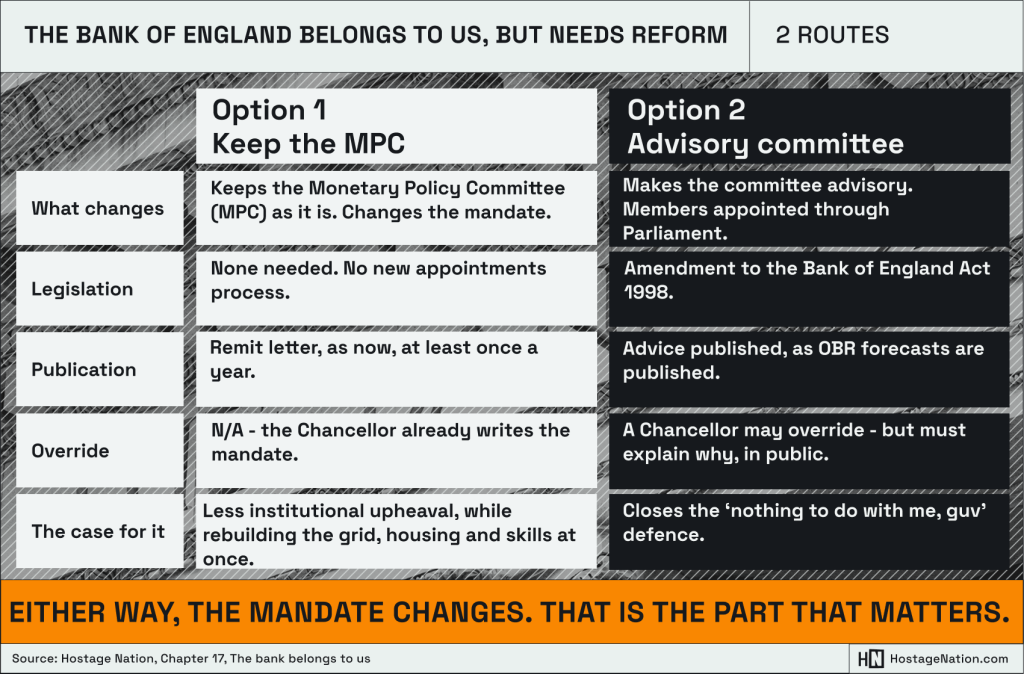
Text description of The Bank of England belongs to us, but needs reform
Option 1, Keep the MPC:
- What changes: keeps the Monetary Policy Committee (MPC) as it is; changes the mandate
- Legislation: none needed, no new appointments process
- Publication: remit letter, as now, at least once a year
- Override: not applicable, the Chancellor already writes the mandate
- The case for it: less institutional upheaval, while rebuilding the grid, housing and skills at once
Option 2, Advisory committee:
- What changes: makes the committee advisory; members appointed through Parliament
- Legislation: amendment to the Bank of England Act 1998
- Publication: advice published, as OBR forecasts are published
- Override: a Chancellor may override, but must explain why, in public
- The case for it: closes the “nothing to do with me, guv” defence
We think the second option is better. But nothing in this report requires it. The financing model set out here does not depend on what the committee decides, or on who sits on it.
None of this requires legislation.
“The Bank of England belongs to the British people. It’s time it started acting like it.”
Footnotes
- Bank of England Act 1998 and Financial Services Act 2012. The Monetary Policy Committee has nine members: the Governor, three Deputy Governors, the Bank’s Chief Economist, and four external members. The Governor and Deputy Governors are appointed by the Crown on the recommendation of the Prime Minister, advised by the Chancellor; the four external members are appointed directly by the Chancellor. Section 11 of the 1998 Act sets the MPC’s objectives — price stability, and subject to that, support for the government’s economic policy — and section 12 requires the Treasury to specify the inflation target and the government’s economic policy objectives at least once every twelve months. Section 19 gives the Treasury a reserve power to direct the Bank on monetary policy where it is satisfied that directions are required in the public interest and by extreme economic circumstances; such an order lapses unless approved by Parliament within 28 days. Under the financial stability framework established by the Financial Services Act 2012 and the Banking Act 2009, the Treasury may direct the Bank in circumstances where public funds are at risk. The point is not that these powers are routinely used — the section 19 power never has been — but that they exist, and that the target, the remit and the appointments are all set by elected government. ↩︎
- Protocol 15 to the Treaties, the United Kingdom’s opt-out from the third stage of economic and monetary union, expressly disapplied the central bank independence provisions to the UK, and preserved the Bank of England’s Ways and Means facility notwithstanding the prohibition on monetary financing, for as long as the UK did not adopt the euro. Britain therefore held an explicit right to an overdraft at its own central bank for the whole period of its membership thereafter. An acceding state would not inherit that protocol. It would join with a derogation on the euro, as Sweden and Poland did, and the independence provisions apply to derogation states in full; the European Central Bank assesses compliance in its periodic Convergence Reports. On the current treaty text, accession would require the repeal of the Treasury’s reserve power of direction under section 19 of the Bank of England Act 1998, and probably a statutory rather than annual specification of the price stability objective. The financing model set out in this report is not affected: borrowing from savers and pension funds through non-tradable instruments is ordinary borrowing from the private sector. ↩︎
- Treasury Committee, Quantitative Tightening, February 2024, citing estimates of lifetime losses across the QE and QT programmes. The OBR’s estimate of the lifetime net loss on the Asset Purchase Facility has moved substantially between forecasts: £63 billion in March 2023, £126.0 billion in November 2023, £104.2 billion in March 2024 and £115.7 billion in Autumn 2024. More recent estimates are higher: the House of Commons Library and NIESR both put the net lifetime cost of the APF at around £160 billion. On the Bank’s uniqueness: the Treasury Committee records that the Bank was among the first central banks in the world to undertake active QT, and that other major advanced-economy central banks — the Federal Reserve, the European Central Bank and the Bank of Canada — are proceeding with passive runoff only, allowing holdings to mature without replacement. The Bank began active gilt sales on 1 November 2022. The distinction matters: the Bank is not unusual in shrinking its balance sheet, it is unusual in selling into the market to do so. In fairness to the counter-argument, the Bank’s Asset Purchase Facility Quarterly Report, 2026 Q2, sets out scenarios in which the debt-servicing savings generated by QE substantially or fully offset the lifetime transfers from the Treasury to the APF, giving a combined range of between -£70 billion and +£65 billion. That analysis concerns the QE programme as a whole rather than the decision to unwind it by active sale, which is the specific policy at issue here. ↩︎
- The Bank of England’s staff assessment, August 2025, estimates that quantitative tightening has raised long-term UK interest rates by 15 to 25 basis points cumulatively since February 2022. Applied to the average new UK mortgage of £205,298 over a 25-year term at the prevailing average two-year fixed rate, a 20 basis point increase equates to approximately £24 a month, or £280 a year. Independent estimates run higher: Milas (December 2025) puts the effect at 25 to 37 basis points, which would imply £430 to £530 a year. Average mortgage size from Q1 2026 lending data; average rate from the House of Commons Library, June 2026. ↩︎
- Commercial banks were paid no interest on their central bank reserve balances until the Bank’s reformed Sterling Monetary Framework took effect on 18 May 2006. Before that the Bank implemented monetary policy by keeping the banking system short of cash and lending at its official rate, an approach that requires reserves to be scarce.
The 2006 reform was undertaken to reduce the volatility of overnight market rates, which between 2002 and 2006 diverged materially from the official rate; the first of the four objectives set out in Reform of the Bank of England’s Operations in the Sterling Money Markets, April 2005, was overnight rates in line with the MPC’s rate out to the next decision date with very limited day-to-day volatility. The mechanism was reserves averaging: banks set voluntary reserve targets which they were required to meet on average over the maintenance period between MPC decisions, and balances averaging within a tolerance range around the target were remunerated at Bank Rate. Remuneration was the condition that made a voluntary target viable rather than the object of the reform. Balances under that scheme were measured in tens of billions.
In March 2009, alongside the launch of large-scale asset purchases, the reserves-averaging scheme was suspended and all reserve balances were remunerated at Bank Rate; that is the arrangement still in force. The Bank has since revised the quantity of reserves repeatedly, and is at present transitioning to a repo-led, demand-driven framework in which the stock is set by bank demand through the Short-Term Repo and Indexed Long-Term Repo facilities. The rate paid on the whole stock has not been altered since 2009.
Two points of fairness. The volatility objective that motivated the 2006 reform has been questioned by the Bank’s own staff: Osborne, Monetary policy and volatility in the sterling money market, Bank of England Staff Working Paper No. 588, April 2016, finds that overnight volatility had little effect on longer-term rates and none on three-month Libor, and that the results give limited support for prioritising volatility reduction in framework design. Staff working papers do not represent the views of the Bank.
And the Bank’s Executive Director for Markets has observed that the framework now being adopted resembles the 2006 arrangement — “you could say it was repo-led and demand-driven” — so the current position is transitional by the Bank’s own account rather than settled (Victoria Saporta, Learning by doing, Bank of Finland and SUERF conference, Helsinki, 11 June 2025).
On the size of the balances and the cost: the total stock of UK central bank reserves fell from £706.7 billion in March 2025 to £643.5 billion at end-February 2026, the reduction driven principally by APF sales and maturities and by repayments of Term Funding Scheme drawings (Bank of England, Report on the Bank’s official market operations, March 2025–February 2026). The figure given in the text is the stock multiplied by Bank Rate and is an order of magnitude rather than an audited total. The nearest audited figure is for the largest single component: the Bank of England Asset Purchase Facility Fund Limited Annual Report 2025-26 records interest payable at Bank Rate on the APF loan of £24.6 billion in 2025-26, down from £35.0 billion the previous year, the fall reflecting both the shrinking stock and the lower Bank Rate. Interest on the APF loan and interest on total reserves are distinct quantities and should not be read as the same number. Between 2009 and 2022 the APF transferred a cumulative £123.9 billion to the Treasury before the position reversed; the first quarterly transfer in the opposite direction, from the Treasury to the APF, was made in October 2022. ↩︎ - Shareholding data for Lloyds Banking Group, mid-2026: BlackRock 9.71%, Norges Bank Investment Management 3.39%, Vanguard 3.18%. ↩︎
- On the pre-2006 framework and the change made in 2009, see the note above. The argument for tiering does not depend on returning to a scarce-reserves system, which is not available at current levels. Tiering leaves the marginal pound remunerated at Bank Rate, which is what anchors market rates, and so differs from proposals to end remuneration altogether — costed at around £35 billion a year and assessed by fact-checkers as overstated; neither NEF nor the IFS supports that figure. Estimate: New Economics Foundation, November 2023, that requiring banks to hold 10% of their liquid assets in non-interest-bearing reserves would save £11.5 billion a year, or £55 billion over five years, against around £30 billion paid out in 2023. Ten per cent is below the level operated in the United Kingdom during the 1970s; the European Central Bank’s current 1% reserve requirement would save considerably less. The saving scales with Bank Rate and with the stock of reserves, which is falling as the asset purchase facility unwinds, and it is bounded by the Bank’s Preferred Minimum Range of Reserves, its own estimate of the reserves the system needs for settlement and precaution, most recently in the region of £365 billion to £515 billion against a stock of £643.5 billion. Tiering below that range would produce scarcity rather than savings, so the practicable saving is a function of the surplus above it and shrinks as quantitative tightening proceeds. On the international comparison: the tiered systems operated by the European Central Bank between 2019 and 2022, and by the Swiss National Bank and the Bank of Japan, were introduced under negative or near-zero policy rates, and in the European case the effect was to exempt part of banks’ balances from a negative rate rather than to reduce a payment to them. The comparison establishes that a single rate on the entire stock is not the only available design, not that other central banks have adopted tiering in order to save money. UK Finance argues that remunerating reserves below market rates amounts to a tax on the banking sector, with potential financial stability implications if large enough. Readers who want the full case either way should start with the NEF paper and with Andrew Bailey’s lecture on central bank reserves, London School of Economics, 21 May 2024. ↩︎
- Calculated at £37,050 per post per year: a salary of £28,000, employer National Insurance at 15% on earnings above the £5,000 threshold, and an employer pension contribution at 20%, consistent with typical Local Government Pension Scheme employer rates. On this basis £11.5bn covers around 310,000 posts; we round down to 300,000. The figure is a wage bill and does not include buildings, energy or other running costs. The gross cost overstates the net cost. Employer National Insurance is returned to the Exchequer immediately, and income tax and employee National Insurance on a salary at this level return a further sum, giving a certain return of around a fifth before any wider effects. Applying the fiscal return used elsewhere in this report would raise the number of posts affordable for the same net cost by around two thirds. We do not claim that figure as a headcount. Recruitment on that scale would need to be tested against the availability of labour in the way set out in Chapter 28, and the fiscal return depends on those recruited not already being in work. ↩︎
- Following the UK’s exit from the Exchange Rate Mechanism in 1992, the government adopted an inflation target and, from 1994, published the minutes of the Chancellor’s monthly monetary meetings with the Governor — an arrangement known in the press as the “Ken and Eddie show,” after Chancellor Kenneth Clarke and Governor Eddie George. Interest rates remained the Chancellor’s decision until operational independence was granted in May 1997. Clarke set out the June 1996 disagreement himself in the House of Commons on 17 July 1996, stating that the minutes published that day showed the Governor had, on balance, thought rates should remain at 6%, and that he had decided to move to 5.75%. He described it as a fine judgement. A general election was required by May 1997 and was held on 1 May. Hansard, HC Deb 17 July 1996. Britannica records that George later acknowledged Clarke had been right to overrule him and hold rates down, as signs of a slowdown became clear through 1995 — a point worth retaining, since the case made here is about the value of publication rather than about who had the better forecast. ↩︎