
Section 4: Raising the money · Chapter 16
Taxing wealth and digital profits
Reading time: 5 minutes 30 seconds
In this section
To ensure the off-market investment strategy operates with price stability, we must pair credit creation, and borrowing of any kind, with disciplined fiscal management.
A state with a sovereign currency can create, borrow, earn or tax money. But price stability is a key component of the stability our proposal brings. Capital projects are funded off-market. Clean economic growth repays this through increased tax base, and increased receipts repay it through earnings.
Day-to-day running costs, known as revenue costs, also need to be in balance. Targeted, structural taxation is the primary method, not least because the structures already exist.
Although the state could just create all the money it wants, to avoid inflation money creation needs to be balanced by money cancellation and increased real assets. The primary short-term mechanism to do that is taxation. Rather than describe the full accounting process of creation and destruction of ledger entries, we’re using the shorthand of just calling it tax.
We should tax wealth. This is not about penalising success. It‘s about moving capital out of speculation and into things that keep people safe. It is perverse that as a country we tax earned income from work at a far higher rate than unearned income from wealth. This alone makes the rich get richer while the poor get poorer.
“Anyone serious about tackling the size of the overall welfare bill needs to get serious about ending structural wealth inequality.”
The Green Party proposes 1% on assets above £10 million and 2% above £1 billion. Other models have been proposed, at different rates and thresholds.1 The design is up for debate, the principle is not. Alternatives have been suggested such as a suite of taxes on investment income, including a 15% surcharge on interest, dividends and rents with the first £5000 exempt, which may be quicker to implement than a wealth tax on a full estate.2
And by the way, a billionaire doesn’t have to build, invent or lead anything to become richer. According to Gabriel Zucman’s 2024 G20 report, billionaires’ capital taxes average just 0.3% of their wealth per year.3 That’s 0.3% of everything they own. Ask a minimum wage worker what share of their earnings disappears in tax and national insurance. Even after a wealth tax of 2%, even after accounting for inflation, someone with £1 billion will be £21 million a year better off without doing any work.4
And we should put teeth into the digital services tax.
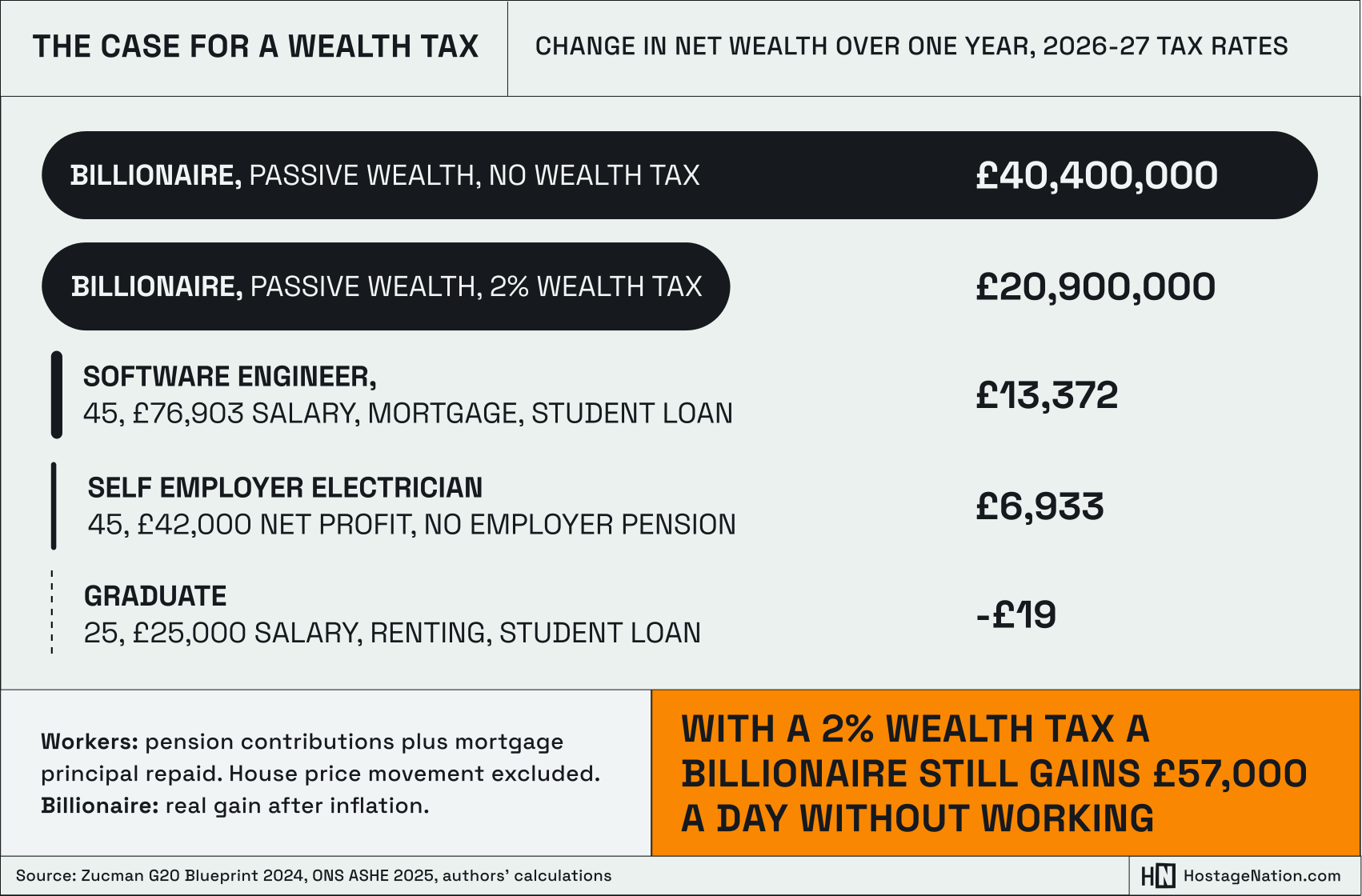
Text description of The case for a wealth tax
Change in net wealth over one year.
- Billionaire, passive wealth, no wealth tax: gains £40,400,000
- Billionaire, passive wealth, 2% wealth tax: gains £20,900,000
- Software engineer, 45, £76,903 salary, mortgage, student loan: gains £13,372
- Self-employed electrician, 45, £42,000 net profit, no employer pension: gains £6,933
- Graduate, 25, £25,000 salary, renting, student loan: loses £19
For workers, the figure is pension contributions plus mortgage principal repaid, with house price movement excluded. For the billionaire, it is the real gain after inflation. The point made: with a 2% wealth tax a billionaire still gains £57,000 a day without working. Source: Zucman G20 Blueprint 2024, ONS ASHE 2025, authors’ calculations.
We already have one. It charges 2% on UK revenues from the largest search engines, social media platforms and online marketplaces, and raised £944 million last year. Set that against what it is patching over. TaxWatch estimates that seven US technology groups made almost £15 billion of profit from British customers in 2021, and were liable for around £753 million in UK tax. In an earlier study of five of the same companies, the effective rate on their estimated UK profits was 2.9%.
Their avoidance mechanisms are legal. Services are sold between companies inside the same group, at prices the group itself sets, until the profit has moved somewhere it will barely be taxed.
Raising the rate to 10% – the level Labour proposed in opposition before quietly dropping it, and which the Liberal Democrats still support – would leave these companies highly profitable in Britain and raise a few billion more. It would not balance the books on its own. But a market where the biggest players pay 2.9% and their British competitors pay the full rate is not a market. It is a subsidy for size.5
There is one more reason to hold the line. Britain is currently under pressure from Washington to cut or scrap this tax, in exchange for relief on tariffs. A country that cannot decide how to tax companies operating on its own soil, without asking another government first, is not sovereign. It is a tenant.
The purpose of these taxes is not just to raise revenue, but to act as an economic regulator. By taxing hyper-concentrated, stagnant wealth pools, we disincentivise the accumulation of excess liquidity that fuels asset price inflation, luxury speculation, and rent-seeking behaviour. We’re incentivising socially useful investment instead.
Footnotes
- Gabriel Zucman, A Blueprint for a Coordinated Minimum Effective Taxation Standard for Ultra-High-Net-Worth Individuals, EU Tax Observatory / Brazilian G20 presidency, June 2024. Zucman proposes a coordinated global minimum tax of 2% of wealth per year on billionaires, arguing that income-based reforms cannot reach the core of the problem, since most billionaire wealth consists of unrealised gains that never appear as taxable income at all. On valuation, he notes that roughly half of global billionaire wealth sits in publicly listed shares with an observable market price, and that privately held wealth can be valued using formulas based on book value and profit multiples, as Switzerland already does, drawing on business data tax authorities collect for corporation tax purposes in any case. On avoidance, he points to evidence that the scale of leakage tracks the strength of third-party reporting rather than the tax itself: a 1% wealth tax reduced reported wealth by under 1% in Sweden and Denmark, which have extensive reporting, against 23–34% in Switzerland, which has none. On relocation, he argues capital flight is a policy choice rather than an inevitability, pointing to the US practice of taxing citizens on worldwide income regardless of residence as a precedent for a “trailing tax” applied after departure. ↩︎
- Richard Murphy, Taxing Wealth Report 2024, Finance for the Future / Tax Research UK, April 2024, taxingwealth.uk. Murphy takes a different approach to taxing wealth from Zucman’s, but with the same ultimate objective. The report sets out around thirty changes to existing UK taxes — rather than a new wealth tax — which Murphy estimates could raise up to £90 billion a year, almost entirely from the best-off tenth of the population. Individual measures include a 15% surcharge on investment income (interest, dividends and rents, with the first £5,000 exempt), taxing capital gains at income tax rates (£12bn a year), restricting pension tax relief to the basic rate (£14.5bn a year), and equalising National Insurance rates across all earned income (up to £12.5bn a year). Murphy’s case is that wealth in the UK is taxed far more lightly than income from work, and that closing that gap through the existing tax system is administratively simpler and faster to implement than introducing an annual wealth tax, which would require new valuation machinery HMRC does not currently have. ↩︎
- Gabriel Zucman, A Blueprint for a Coordinated Minimum Effective Taxation Standard for Ultra-High-Net-Worth Individuals, commissioned by the Brazilian G20 presidency, published 25 June 2024. ↩︎
- The £21 million figure is the author’s own calculation, not a figure from a published source. The assumptions are set out here so that readers can test them, and are deliberately conservative.
Starting position: an individual holding £1.01 billion, invested passively. Assumed nominal return on a diversified portfolio, 7% a year. Existing effective tax on wealth, 0.3% a year, per Zucman. Inflation, 2.6%, per ONS. Wealth tax, 2% on wealth above a £10 million threshold.
Without a wealth tax: an investment gain of £70.7 million, less £3.03 million in existing tax, gives £1,077.7 million at year end. Adjusted for inflation that is £1,050.4 million in start-of-year terms, a real gain of £40.4 million, or 4.0%.
With the wealth tax: the bill is £20 million on the £1 billion above the threshold, giving £1,057.7 million at year end, or £1,030.9 million after inflation. A real gain of £20.9 million, or 2.1%.
The result is sensitive to the return assumption. At 6% nominal the real gain falls to about £11 million; at 5%, to roughly £1 million, or break-even; at 9%, to about £41 million. A poor year could erase it altogether — as it could for anyone with a pension invested in the same markets. The claim is not that the gain is guaranteed. It is that a 2% wealth tax roughly halves the rate at which passive wealth compounds, and never touches the principal.
Note that this understates the effect described in the source. Zucman finds that ultra-high-net-worth individuals have seen their fortunes grow by 7.5% a year in real terms over the past four decades, and calculates that a 2% minimum would reduce their net-of-tax return from 7.2% to 5.5%. On those figures the same individual would be around £55 million better off, not £21 million. The lower figure is used here.
Sources: Gabriel Zucman, A Blueprint for a Coordinated Minimum Effective Taxation Standard for Ultra-High-Net-Worth Individuals, commissioned by the Brazilian G20 presidency, published 25 June 2024; ONS consumer price inflation data. ↩︎ - The Digital Services Tax was introduced on 1 April 2020: a 2% charge on UK-derived revenues from search engines, social media platforms and online marketplaces, applying to groups with more than £500 million in global in-scope revenue and more than £25 million from UK users. It raised £380 million in 2021-22, £808 million in 2024-25 and £944 million in 2025-26. Around 90% of receipts came from five business groups in the first year, and only eighteen companies paid it at all. Administration has been notably cheap: HMRC implemented the tax for £6.3 million, below budget. The OBR projects receipts of £1.4 billion by 2030-31. The government reviewed the tax in November 2025 and proposed no changes, while restating its commitment to removing it once an international agreement is in place.
On the underlying avoidance, TaxWatch estimates that seven large US technology groups — Apple, Microsoft, Meta, Amazon, Adobe, Cisco and Alphabet — generated almost £15 billion of profit from UK customers in 2021 but were liable for around £753 million in UK tax, against roughly £2.8 billion had the profits been taxed where earned. An earlier TaxWatch study of five of these companies found estimated UK profits of £8.1 billion in 2018 against £237 million paid, an effective rate of 2.9%. For context, HMRC’s own estimate of corporation tax avoidance by all large companies is around £700 million a year — a figure that excludes profit shifting, which is the mechanism at issue here.
On pass-through: the effect varies by business model. Amazon responded to the DST by adding a corresponding fee for marketplace sellers, and there is evidence of similar treatment of advertisers. Advertising revenue is harder to pass on, because auction prices are set by what advertisers will bid rather than by the platform’s costs. Any increase in the rate should be designed with pass-through to third-party sellers in mind. ↩︎